A browser is not a VPN. Keeping a file out of the Files app does not hide your IP address from sites you visit or from your network operator. Tracking protection is list-based and not absolute: known ads, analytics, and social trackers from bundled lists are blocked on the device, but no blocker catches everything. Private Browser Incognito is rated 17+ for unrestricted web access and is intended for adults. The vault is optional Stealth Suite. We do not replace Files.
Files is Apple’s. It is the shelf on iPhone for documents you want to find, share, and hand to other apps. That is a good product for that job. It is the wrong product for a download you saved because you did not want it on a shelf.
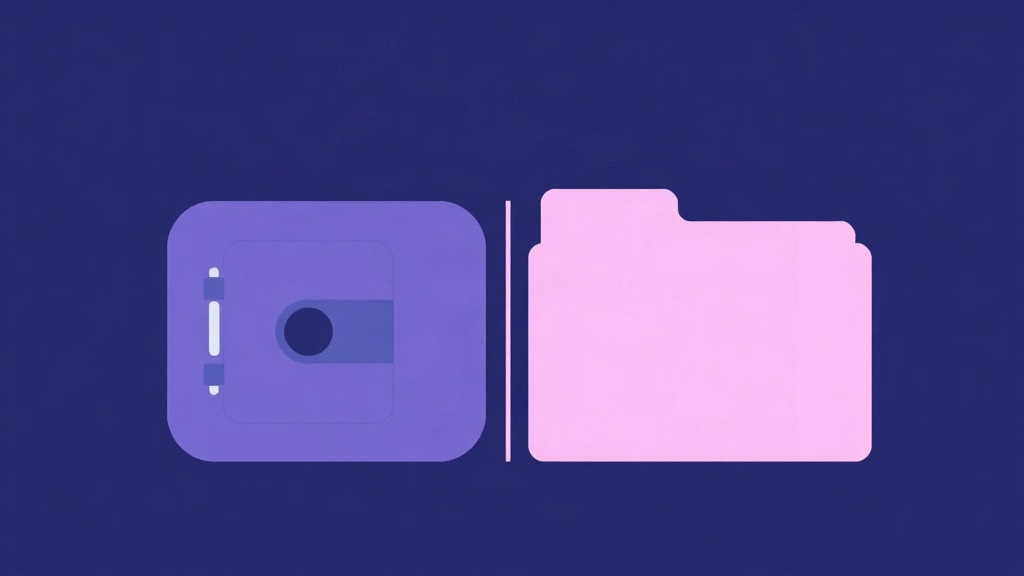
The Stealth Suite vault is a sealed store inside Private Browser Incognito. AES-256, no plain copy on disk, excluded from backups. It is not a cloud drive. It is not a replacement for Files. This page is the split: when a folder is the right tool, when a box inside this browser is the right tool, and what erase and panic do to each. The vault as a feature is An Encrypted Download Vault on iPhone.
Files is a shelf. A vault is a box
The Files app exists so people can browse storage. Locations appear. Other apps can ask to open or save there. A person who unlocks the iPhone can tap the Files icon without opening your browser. That visibility is the design. If you keep invoices you need in a meeting, you want that machine.
A vault is built the other way. The file stays inside this app, behind App Lock, opened from here. It does not appear as a user-visible folder in Files. Someone who is hunting through On My iPhone is not supposed to trip over it. We will not name internal storage flags as if they were consumer documentation. The user-facing fact is enough: the download is not promoted onto Apple’s shelf.
We do not claim the vault replaces Files. Use Files for the documents that belong in Files. Use the vault when the whole point of the save was to stay out of that browser of folders. Pretending one app ate the other would be a different, dishonest product. Private Browser Incognito is a web browser with an optional box. It is not a file manager for the phone.
What the vault actually is
AES-256 is the cipher name. We do not call it military grade. There is no plain copy on disk. Files are excluded from backups. There are no accounts and no app server for browsing. The App Store privacy label is Data Not Collected. We do not host a folder with your name on it. Cipher details without slogans live in AES-256 in the Vault, Explained Without Hype.
App Lock with a six-digit passcode and Face ID is free. When you use the vault, that lock is also in front of the files. The passcode is never stored. It becomes the key. Forgotten passcodes cannot be recovered. If you forget it, data sealed under it is permanently inaccessible, by you or by us. That is not a support article we can reverse later.
Keep a separate copy of anything irreplaceable before you depend on a store that can vanish with the phone, the key, panic, or an optional self-destruct wipe. Encryption is not a spare in the sky. Excluded from backups is a refusal to make that spare. The backup article is Vault Files and iCloud Backup.
Not a cloud drive, not a Files clone
People hear encrypted and picture a branded folder that follows them to a new phone. That product needs an account and someone’s computers. This app does not offer that. Restore a replacement iPhone and vault files do not appear from us. We never received them. A lifetime Stealth Suite purchase can restore access to the features on a device where you install the app. It cannot materialize files that lived only on the old flash.
Files participates in Apple’s world of locations and sharing. We will not claim we control those screens. We will not invent operating-system API names. We will not say Apple’s UI will always show a particular line because of us. We will say what we build: a sealed store that is not supposed to ride along in backups and is not supposed to show up as a browseable folder.
Network the app makes: pages you open, search you send if you search, downloads you start, StoreKit if you buy the suite. Block lists ship in the app. Suggestions stay off until you agree to share a keystroke. None of those paths is a sync pipe for the vault. If you needed the same file in two places, you would copy it yourself by a path you accept. That copy would be your risk. We do not build the pipe.
Photos is another shelf. Erase is another verb
Photos is the gallery cousin of Files. Memories, widgets, and other apps treat it as content to surface. A clip that lands in Camera Roll is a household object. Why downloads should not land there is Why Downloads Should Not Land in Photos. The Files comparison is the same idea aimed at folders instead of tiles. Two Apple shelves. One optional box inside this browser.
One-tap erase closes every tab and destroys cookies, cache, and site data. It does not clear the vault. Auto-Erase, if you enable the timer, is still a session control: Off, Every time you leave, After 1 minute, After 15 minutes, After 1 hour, After 8 hours, After 1 day, After 1 week. Leaving the app does not empty the box. That is why a leave timer remains usable for people who also save files.
Panic is the control that takes files: one code at the lock screen silently wipes tabs, the entire vault, and the break-in log, then opens what looks like a fresh start. Self-destruct can optionally take the vault after too many wrong codes. Those wipes are permanent. They are not a request to Files to delete a copy, because the copy was never there. They are not a request to a cloud to drop an object, because the object was never there.
Stealth Suite, prices, and what a lapse does not undo
The vault is Stealth Suite, optional Apple IAP: monthly $4.99, yearly $19.99 with a 7-day trial, or lifetime $49.99. The kit also includes a decoy passcode, panic, the break-in log with optional Intruder Photo, self-destruct, Auto-Erase, and icon colors (Midnight, Ocean, Ember). Icon colors recolor the shield. They are not calculator disguises. The decoy opens a clean empty browser. Vault contents stay behind the real key.
If a subscription lapses, protections you already enabled keep working and the vault stays accessible. New downloads that require an active unlock follow the lapse policy in the terms. We do not hold existing files hostage. A lapse is not a migrate-to-Files export. The files stay in the box or they are wiped by a tool you armed. They do not spill onto Apple’s shelf because a receipt expired.
The free product remains the forgetful engine: no history file, on-device Disconnect lists, one-tap erase, HTTPS-Only Mode, search without suggestions until you ask, per-site camera and microphone as websites request them, and App Lock. You can live on that engine and never buy a vault. Pages still forget themselves. Files you save some other way still land where that other way puts them, including Files, if you chose that.
Honest limits a folder argument does not cancel
Keeping a download out of Files does not hide your IP. The site that served the file saw the request. Your network operator saw a destination. On-device blocking still misses names. HTTPS-Only Mode still does not hide the host. The 17+ rating still means unrestricted web access. You are responsible for what you download and for using the app lawfully. We do not publish a list of hosts.
We do not claim fingerprint spoofing, Tor, a proxy, or IP hiding. Private Browser Incognito is iOS only. It is not Android, not desktop, not a password manager. We do not claim the vault is invisible to every forensic lab or to a person with the unlocked phone and the real passcode. We claim it is not sitting in Files for the next tap.
If you are choosing a destination, a compact table is more useful than adjectives.
| Property | Files app (Apple) | Encrypted vault |
|---|---|---|
| Whose product | Apple’s. We do not replace it | Stealth Suite, inside this browser |
| Audience | Anyone who opens Files | Someone who unlocks this app |
| Plain copy on disk | A normal document on a shelf | No plain copy. AES-256 |
| Backups | Part of the usual device story | Excluded from backups |
| Session erase | Unrelated | Leaves the vault intact |
| Cloud drive | Apple’s locations, not ours | Not a cloud. No account with us |
Use Files when you want a document on Apple’s shelf. Use Photos when you want a picture in the gallery. Use the vault when the download should stay in this app, sealed, out of both shelves, bound to this device and this key. Panic if the box should die with the tabs. Erase if only the session should die. Private Browser Incognito will not pretend it replaced Files. It will not host a copy we never took. The folder and the box can exist on the same iPhone. They should not be sold as the same app.
 Private Browser IncognitoFree on the App Store. No history, on-device blocking, one-tap erase.
Get the app
Private Browser IncognitoFree on the App Store. No history, on-device blocking, one-tap erase.
Get the app
Frequently asked questions
Does the encrypted vault replace the Files app?
No. Files is Apple's. We do not claim to replace it. The vault is a sealed store inside Private Browser Incognito for downloads you choose to keep there. Use Files for documents you want on Apple's shelves. Use the vault when the file should not appear in Files at all.
Are vault files stored in the Files app?
No. Vault downloads stay inside this app. AES-256, no plain copy on disk, excluded from backups. They are not promoted into a user-visible folder someone can browse in Files. That is the point of a box that is not a library.
Does session erase empty the vault?
No. One-tap erase and Auto-Erase destroy the browsing session and leave the vault intact. Panic code can wipe the entire vault with the tabs and the break-in log. Self-destruct can optionally take the vault after too many wrong codes. Those wipes are permanent.
Is the vault a cloud drive?
No. There are no accounts and no app server for browsing. We do not host your files. Excluded from backups means the sealed downloads stay on this iPhone. Restore another device and there is nothing of ours to fetch. AES-256 is the on-device cipher name, not a slogan for a folder in the sky.
Why keep private downloads out of Files?
Files is built to be found. Other apps can request access. People who unlock the iPhone can open the folder. A vault is built to stay behind this app's lock. Keeping a file off that shelf is not anonymity on the network. Sites you downloaded from still saw your IP. A browser is not a VPN.